Archive for the ‘Art Community’ Category

FFF 2015 An Evening With Sam Rockwell Featuring Moon

May 2, 2015
Sam Rockwell is Interviewed on the Enzian Stage

What is the Most Quoted Movie Line of All Time–In Your Family?

Everyone who loves movies, has their favorite movie quote. It’s so ubiquitous, the American Film Institute even has a list of the top 100 movie quotes of all time. Number One on the list is, “Frankly, my dear, I don’t give a damn,” from Gone With the Wind. Number Two is, “I’m goinna make him an offer he can’t refuse,” from The Godfather. Not in the LanceAround family! The most quoted movie line in our household was actually spoken by Sam Rockwell. You can hear him make a guess as to what it is below. First, let’s talk about the movie we saw tonight (which does not have our favorite quote) and Sam’s interactions with the FFF faithful.

Moon is a 2009 sci-fi thriller about Sam Bell, a solitary worker on the moon coming to end of his three year contract to mine a newly discovered energy source. He’s looking forward to going home but an accident causes a series of events and discoveries that turns his lonely existence upside down. Sam Rockwell stars as Sam Bell and Kevin Spacey voices the sophisticated computer, GERTY, that assists him. The story was conceived and directed by Duncan Jones with stunning art direction by Hideki Arichi and Cinematography by Gary Shaw.

After being treated to this wonderful film, Sam Rockwell came onto the Enzian stage for an interview and audience Q & A.

Sam Takes Questions From the Audience

Sam Takes Questions From the Audience

“Thank God for Duncan Jones,” said Sam, “He really gave me a great part.” Sam goes on to say that Duncan offered him a “bad guy” role in a movie, but he was tired of playing the bad guy. Duncan asked him what he wanted to play and he replied, “Sci-fi.” He goes on to describe his role in Moon as a “working class” sci-fi character. Kevin Spacey did not accept the role of the computer voice for GERTY until after the film was shot.

Sam’s parents were in the industry, that’s how he got started. While it was in his blood, he says he took it for granted until, at the age of 24, when he took a course with Bill Esper, the world’s foremost studio dedicated to Meisner-based actor training.

Many movie goers became familiar with Sam from his breakout performance in Galaxy Quest. He portrayed an aging actor who once had a bit part in a very popular sci-fi TV show but is now relegated to signing autographs for die hard “Questarians” at their annual conventions. His spunky, energetic performance earned him high praise.

During the Q & A, LanceAround told Sam that in the LanceAround Household, the most popular repeated movie quote is one of his. Here’s a video of LanceAround encouraging Sam to guess which quote might be the family favorite:

It was clear the audience at the Enzian loved Sam. One of them said they noticed that Sam dances in a lot of his roles and insisted he stand up and dance. Another kept asking him to bartend at the Enzian bar after the show, just like Cloris Leachman had done back in 2012. One encouraged him to direct a movie, but Sam maintains he’s too lazy to direct. He acknowledged, however, that he has no other talent and if he couldn’t act, he has no idea how he might earn an income.

Unlike many well known Hollywood actors, Sam comes across as very humble and self-effacing. He’s a genuine guy. And if you didn’t get to see him at the Enzian, well, as everyone in the LanceAround family would say…[click on link below…]

FFF 2015 Day 10 Pervert Park

May 2, 2015
A Hard Hitting Documentary That Poses Questions Difficult to Answer

A Hard Hitting Documentary That Poses Questions Difficult to Answer

Mrs. LanceAround and I decide to end our 2015 FFF by watching the documentary Pervert Park. After 10 days of intense film watching, mostly documentaries, this film provided a powerful ending to a fantastic film festival.

This well made documentary centers around a trailer park in St. Petersburg, FL, just down the road from Orlando, that houses people who are registered sex offenders. The range of sex offenses causing someone to be registered are many and varied.

One offender was a very young man who was invited to have sex, online, with a 30 year old woman. He was gung-ho, until the woman encouraged him to include her 14 year old daughter. According to him, the woman continued to insist until he agreed, with one sentence, to perform a sex act with the 14 year old. When he showed up, he discovered it was an undercover sting operation. Bang. He’s now labeled a sex offender for the rest of his life.

On the other end of the spectrum was the woman who was encouraged to have sex with her father when she was very young. She then claims she had an un-consenting abortion and was told she couldn’t have children. She did have an unexpected pregnancy and gave birth to a son. When her son was eight, at the encouragement of a man who promised he would send her money and solve her problems, she had sex with her own son. Her son went on to sexually abuse another relative. It was heart wrenching to see her tearfully discuss what even she describes as the inconceivable and admittedly repulsive desire to continue to have sex with her father and then with anyone she could have sex with, including her own son. A competent therapist may have helped her to understand that when a young prepubescent child is forced into sexual acts with an adult who is meant to protect them, it is very common to emotionally intertwine the sex act as the way to express and receive affection. Unfortunately, there was never any therapist to help her work through these difficult and complex issues.

Normally, LanceAroundOrlando does not like to discuss such adult themes in graphic detail on a family oriented blogsite. But we believe this is an important social issue that needs to be examined. On the one hand, those branded as sex offenders are often tossed aside by our society. The trailer park in the movie showed numerous examples of vandalism and ill will sent in their direction, including a resident who found a bag of dead rats thrown into his laundry. On the other hand, repeat sex offenders can have difficulty controlling the illegal activities in which they engage. No one wants to see someone else abused, especially when the abuser had been caught once already.

Ironically, the movie reveals that not even the sex offenders want someone to be abused. The film showed some brutal honesty. Offenders readily admit their crime and express tearful remorse. Most offenders are following a pattern of abuse that began when they were abused and continues to trickle down. Group therapy sessions in the movie explore the dynamic of low self esteem which many offenders admit is a big contributor to their issues.

During this movie, the group therapist who works with many of the residents at the trailer park highlights the downhill spiral that keeps these people from finding redemption. They are branded for life. Many have to be on expensive probation programs, wear bracelets that greatly restrict their movements and have draconian rules which make it almost impossible to find a place to live, work or play. In short, they have nowhere to go and nothing to do. Understandably, no one wants the sex offender in their backyard. Ironically, this attitude tends to create the dynamics that make it even harder to address this issue. Should we simply kill them? Put them away for life? Ship them to a deserted island? No doubt, there are many in our society who believe we should do these things, even if they have the social skills to refrain from saying so out loud.

The person who founded the trailer park spoke about how she became passionate about this issue when her “perfect” son made that one mistake 20 years ago and wound up in the position that everyone in the trailer park finds themselves. She looks at the camera and asks the documentarian, who is off camera, if she has a child. Upon acknowledgement, she asks if the child is perfect. Of course. So was hers, until he made that “one” mistake.

The movie ends with the most dramatic and powerful credits in any movie I have ever seen. In place of normal credits, the screen shows the webpage of each person who appeared in the movie. A webpage that anyone in the world can easily access. It reveals their name, alias, last know address and the crime they committed. The laws of our country require this webpage to be available for all to see. LanceAroundOrlando fully understands the desire to protect our society. We understand the good intentions of those who create these laws. But the unintended consequences of publicly branding criminals has repercussions that cannot be easily dismissed. We know this is a topic with hard questions and no easy answers. The fact that I have spent this entire blogpost looking at this issue and did not spend it highlighting the filming techniques, directorial choices and/or cinematography is a testament to just how well done this film is. It was so good, it forced us to focus on the issue in the film and not on how the film was created. It is very powerful. I highly recommend it.

An earlier movie at the FFF had a father whose black son was killed by a white man at a gas station for playing loud music. This grieving father talked about the issue of our American society which has 5% of the world’s population yet has 25% of the world’s prisoners. Many of these prisoners are minorities from disadvantaged backgrounds. What makes matters worse is that the prisons in this country are, more and more, being run by for-profit corporations who promise 90% occupancy and a profit back to the governmental agency that contracts with the prison company. In other words, we are now using prisons for profit and dropping any pretense of using our incarceration system as a means for rehabilitation, education and healing. The black father identified this dynamic as a way our society is fueling racism. However, the same statistics highlight a concurrent problem that exists with anyone who comes in contact with our justice system, such as these sex offenders. We do not do enough to seek ways to help people find rehabilitation and redemption.

Lastly, for those who read this blog post and are upset with Mrs. LanceAround and I for bringing more light to these issues, I will give you one final piece of information to consider: I, myself, was sexually abused when I was younger by a man named Frank Fimiano. (I have vowed to myself that I will never reveal this information without also revealing the name of the person who abused me–so I fully understand the desire to publicly brand the offender–Am I trying to punish him or protect others from him? That’s the devil I live with every day.) And I know full well how it is to feel intense hatred towards someone who abuses an innocent person. Still, my better angels tell me there must be some way to find rehabilitation and redemption.

FFF 2015 Day 10 Florida Shorts: Best of Brouhaha

May 1, 2015
Our Friend, Lee Karlinsky, Stars in Down the Road

Our Friend, Lee Karlinsky, Stars in Down the Road

Dictionary.com translates brouhaha as, “A noisy and overexcited reaction to something.”

Judging from the crowd that was entering the auditorium on this last day of the FFF, there was a lot of noisy and excited reactions. Unlike most festival audiences, there was an energy in this room that felt different. People were boisterously greeting one another from across the room. There was an air of camaraderie. It felt like the TV show Cheers where everyone shouts, “Norm” when the character of Norm enters the bar. This crowd was slightly younger than at most FFF films. This made me a little concerned because, sometimes, the films can be intense. Turns out, several of these youngsters were the stars in these films; including Lee Karlinsky who had a role that was peppered with colorful language; totally inappropriate for a lad of his years. (No worries, I spoke to both his parents, aunt and grandparent after the movie and they all assured me that he was only saying what was in the script; at home he never uses such language!)

The Enzian Theatre sponsors more festivals than just the FFF. One of those is the Brouhaha which features movies made in the state of Flordia. From these, the selection committee picked 13 short films for this program. At first, I was concerned that these films would not be as good as other films that came from a wider network and had not planned to see this program. But after meeting Lee and his mother Erica at two previous programs, there was no way I could skip his movie. Turns out, this was a great shorts program!

Down the Road
This is the film that stars our young friend Lee Karlinsky. Although the production values on this movie are not of the same quality as most of the others, the script featured an amusing plot device (very reminiscent of Back to the Future which the film references.) Young Lee handles a challenging role admirably. Part of the difficulty with the script is that the author had difficulty distinguishing between the older and younger self. Often, the younger self was given a line way too mature for his age. The premise of the film helped the audience past these bumps, however, creating an amusing and likeable short.

Beer Battle
An antiquated law in Florida makes it illegal to sell beer in a quart bottle. Ironically, you can sell it in smaller bottles and larger bottles. This creates an issue for local breweries who normally dispense their wares for the customer into a reusable bottle that is traditionally in a size which is illegal. The documentary accuses the established beverage industry of using political power to keep the law on the books.

My Verse
Full Sail University professor Wilson Santos has created a beautifully moving film where he reads a poem he’s written while showing film clips of disadvantaged people around the world. The poem encourages the listener to get involved. Wilson does not tout any one specific charity. Rather, he encourages viewers to research and select a reputable one.

Broken: Rock, Paper, Scissors
This is one of those films where it is essential that you know the title before you watch it. Since I missed the title, I assumed one of the characters was simply a knock off of Edward Scissorhands. I also had no idea why one of the other characters was injured every  time he tried to help. Of course, he was “Rock” and she was “Paper.” In the end…well, this one is poignant enough that I encourage you to see it for yourself. Created at Ringling College of Art and Design, the alma mater of our NumberTwoSon.

Kung Fu Crab
Also from Ringling, this cute short features a Kung Fu Crab, a pet hermit, who is quite capable of inflicting damage on his owner who decided to make a crab cake!

Life in Darkness
Excellent acting and production values in this short overcome a weak script. Two brothers are forced to deal with a difficult past and a very uncertain present.

Death Has a Son
Would the Angel of Death trade sexual favors to spare the life of a woman? Could he conceive a son? Just, exactly, how would that relationship go? The amusing film was only hampered by the reality that Death kills everyone he touches…so he can’t touch his son. But, then again, it never shows how the son was conceived???

AbandonedLove

There’s Lots More Where These Came From

Abandoned Love
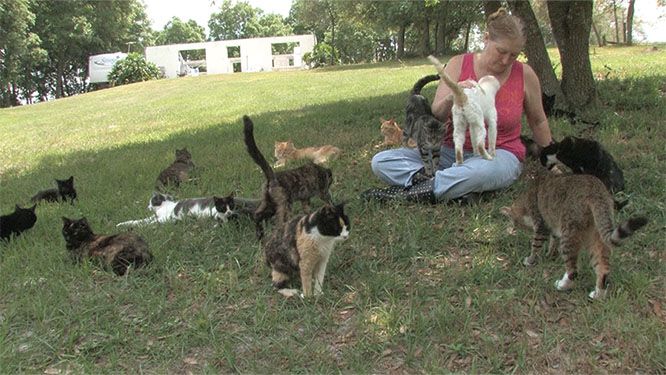
Over 100 abandoned cats are lucky enough to find sanctuary at Cat Tail Corner in DeLeon Springs, FL. However, un-neighborly neighbors contact the authorities with complaints. How will the good hearted Kristy deal with the $80,000 in fines she is assessed? Does she have to close? If you can’t see this movie, I’ve given you enough information to at least Google her. Great documentary.

Fix
In our opinion, this was the best film of this program. A tight, well plotted script combined with exceptional acting and great production values made this tense thriller captivating all the way up to its surprise ending.

Billy the Fetus
Although the production values were not as great in this film, the acting and humorous script were enough to make this one of the more memorable of today’s shorts. You may never look at abortion the same way after seeing this film. Then again, based on the Q & A with the director, that might have been the intention…

Jinxy Jenkins, Lucky Lou
Another CGI short from Ringling, this one is the amusing story of a luckless young man and how his interactions with a charmed young lady create the perfect pairing.

Of Mice and Moon
The final Ringling CGI short is a very brief and cute ditty about a father mouse who helps his young son discover whether or not the moon has cheese.

Dan Behind His Eyes

Loving Father, Doting Daughter

Loving Father, Doting Daughter

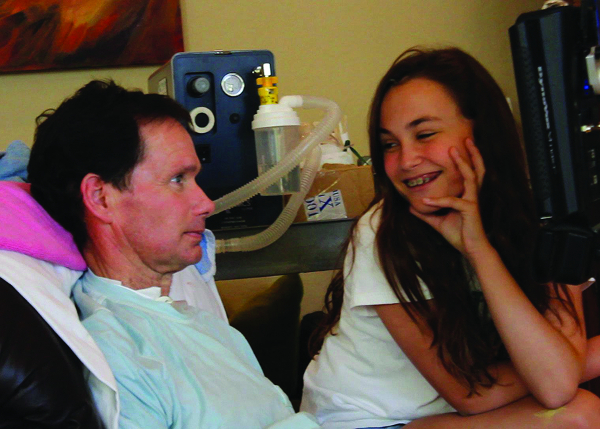
The most emotional of today’s shorts, this documentary tells the story of Dan Ellis, a successful businessman who contracted ALS (Lou Gehrig’s disease.) A total quadriplegic, he learns to paint by using a computer assistant device and telling his 13 year old daughter which colors to mix and how to create the paintings. Samples of his artwork were on display outside the theatre. Very moving and well done doc.

Filmmaker Q & A
Since these were all Florida films, there was a disproportionately larger number of filmmakers in attendance. And that does not include all the actors, technicians and other support staff present.

I asked Ariel Zengotita if he intended his film, Billy the Fetus, to be an anti-abortion film and if he would be okay should the Catholic League want to promote his movie.

He said that the project began as just a humorous exploration, but the more and more he thought about it, the more he became passionate about the subject matter. Later, at the concession stand, we ran into Ariel and he shared with us his parents had actually considered aborting him. Mrs. LanceAround shared that the woman sitting beside her at the theatre sobbed during the entire film.

Both David DeRienzo and Ariel Zengotita gave a shout out to the young actors in their movie, both of whom were present. One of them is our friend Lee Karlinsky who David said got the role when the original person he cast had to attend a bar mitzvah.

Wilson Santos refused my request to quote something from his latest poem, but he did let the audience know he was doing a reading and another screening of his film at a local venue. Unfortunately, I did not get the time or place.

Sarah Allsup told us that the woman in her film who saves cats continues this service. She provided contact information if anyone wanted to help her cover the $50/day cost for cat food.

Sheri Kebbel had the most emotional film. I asked her if her subject saw the movie before passing. She replied that they put together a lot of the movie clips and shared them with him. She also handed out greeting cards that featured artwork done by the subjects in her film. This was clearly an emotional moment for her and her film was deservedly well received.


FFF 2015 Day 9 Do I Sound Gay?

April 30, 2015
Does He??? --  Yes, He Does!

Does He??? — Yes, He Does!

If you can’t handle the answer, then that’s a question you absolutely should be asking!

That sentence sums up the philosophy of David Thorpe, who created this documentary based on the insecurity he felt regarding how his voice and vocal inflections sound. The film was primarily a series of hilarious interviews and media snippets, mostly with gays. It revolved around characteristics that have become stereotypical of gay interactions. It provides amazing insights into some of the psychology behind how people think, act and talk and how these shape who they are and how those around them respond.

It includes very moving interactions, sorrowful recollections, shocking moments of extreme flamboyancy and many poignant scenes of love and acceptance. Although the film is a little monotonous and one dimensional, it was obvious from those around us that the audience connected with it.

Of course, the most common question that everyone was asking at the conclusion of the film was, “Do I sound gay?” Often, the answer was, “Yes!”

FFF 2015 Day 9 International Animated Shorts

April 28, 2015
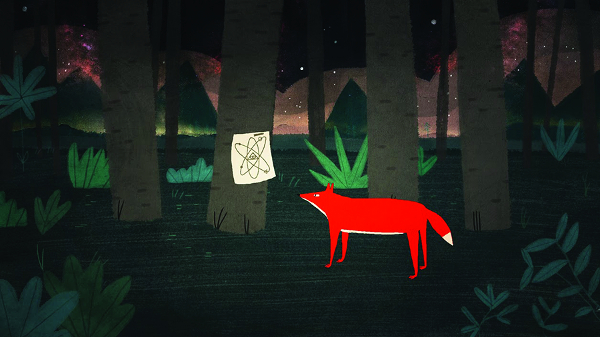
Bear Story

Bear Story

Monday Man
A continuation of a series of shorts about a man who has a difficult time getting started on Mondays. This short features an epic battle with his car’s seat belt while his boss is watching the clock wondering where he is. Well timed and funny. very short.

One Night In Hell
Collection of scenes involving the underworld in a circus type atmosphere. What was amazing about this film wasn’t the story but the filming technique which presented a 3D steeroscopic depiction of Paris in the 1860s. Music score was by Brian May of Queen, who also co-produced.

Symphony 42

Surrealism At Its Best

Surrealism At Its Best

Funny surrealistic world combining humans and animals in unique and thought provoking combinations. Delightfully zany. Winner of the Gold Plaque Special Jury Prize at the Chicago International Film Festival. The audience seemed to enjoy it.

Metamorfoza
Stop motion short dealing with a baby doll that gets caught in a collage of chaos and adventures. Non-sensical. The enjoyment of the film was absorbing the filming technique.

Storm Hits Jacket
This film won the Short Film Jury Award at the 2015 Sundance Film Festival. My only reaction was, “why?” Described as a colorful yet brooding landscape of random absurdity as a monster storm reaches the shores of Brittany.

Teeth
The history of the teeth that came and went in one man’s mouth from birth to age 75, with a little bit of tongue thrown in. Literally, Gross.

Tatuape Mahal Tower

A Model Story?

A Model Story?

A scale model figure for a Brazilian architectural firm tells us of his up and down life, especially when he changes into a gorgeous woman model. One of the better shorts in this program.


Tears of Inge
The true story of the filmmaker’s grandmother singing the tale of camels who would often kill their young after birth and how the early nomads would sing to them in an effort to keep the young camels alive. Using a stop motion painting technique with impressionistic painting, this was colorful and artistic.

The Last Supper
Again we have some kind of creative stop motion film technique with live action and animation. An aging performer creates a last supper and she’s the main dish, literally. Slightly longer than it needed to be.

Day 40
A re-imagining of the Noah mythology by someone who clearly believes there was a much darker side to the story. An irreverent take on one of the most famous stories of all time. Very funny and one of the best shorts in this program.

The Ledge End Of Phil (From Accounting)
Story of a dedicated employee who gets trapped on a ledge and makes friends with a bird who helps him discover his wings. The filmmaker is very talented and had some fabulous directorial moments, but the story was a little weak.

Bear Story
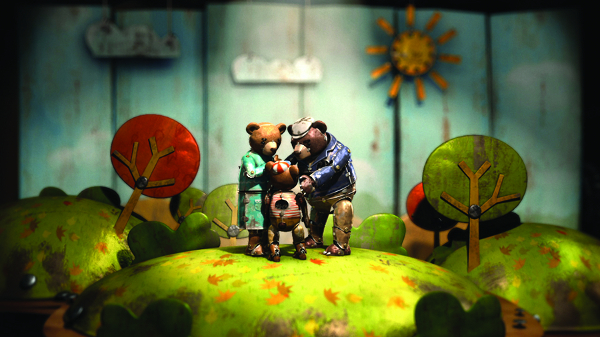
The life of a bear as portrayed by his tin-toy theatre. An animation of an old fashioned device. Combining these two worlds created an amusing look and feel. I did not believe this was the best short, but it did win the audience award for Best International Short this year.

Filmmaker Q & A with Allisi Telengut director of Tears of Inge
“The story is from my grandmother. I recorded her voice and the narration was from her. I’m inspired by the artwork of William Kentridge from South Africa. He makes stop motion with charcoal on the surface. You draw and erase and take pictures. Instead I used color. It’s called “under the camera” animation. My grandparents were nomads when they were younger. This is disappearing. It’s important to preserve their way of living and memories. It took 4 to 5 months to animate. I made a short film before this one about a burial in Mongolia. That one’s about death, this one’s about birth. They were supposed to be together but I couldn’t finish it on time. I like working with color and texture. It reveals my visceral feelings. I tried other animation techniques. But I like working with color.”

FFF 2015 Day 9 – 3 1/2 Minutes

April 28, 2015
What Question Do You Ask a Father Whose Teenage Son Was Tragically Killed?

What Question Do You Ask a Father Whose Teenage Son Was Killed?

The only thing that could have made this documentary more heart wrenching would have been if the father of the teenager killed at the gas station in Jacksonville had been present in the room.

Well, he was there.

The documentary was about the international outcry when Michael Dunn, a white man, pulled into a gas station on Black Friday 2012. He parked next to a group of black teenagers who were playing very loud rap music. He asked the teens to turn the music down, which they did, until one of the teens in the back shouted an expletive and demanded that they turn the music back up. An angry interaction ensued and Michael Dunn got his pistol out of his glove box and began firing 10 shots at the car, killing 17 year old Jordan Davis.

This ignited a media frenzy, including “man on the street” interviews reflecting heated viewpoints on both sides of the issue. Some supported Michael Dunn, who claimed that some kind of barrel, like a shotgun barrel, was pointed at him. They sited Florida’s controversial “stand your ground” law which stipulates that someone does not have to retreat from a confrontation but can use deadly force if he perceives his life to be in danger. Many others see only another dead black unarmed teenager at the hands of a non-black assailant.

There’s lots of evidence that is very damaging to Michael Dunn. For example, he left the scene, went back to his hotel, ordered a pizza with a rum and coke, walked his dog and only then called the police. Although no gun or barrel of any kind was found in the car, it was acknowledged that the car drove away from the gas station, parked and then pulled back into the gas station. The police admitted that it took them four days to search the area where the car temporarily parked when the teenagers fled from the firing bullets. It was also acknowledge that Jordan Davis got into a heated, expletive filled banter with Dunn. There is conflicting testimony as to whether or not he threatened to kill him. In the end, Michael Dunn’s assertions that he told his fiance about the “gun” he saw the teenagers have was directly contradicted by her. She also testified that when they pulled in to the gas station, he stated how much he hates that “thug music.” This, again, directly contradicted his own testimony. Although the first trial ended in a hung jury on the count of first degree murder, a second trial found him guilty and he will spend the rest of his life in prison. When the documentary revealed this fact, the audience broke into applause.

Perhaps the most telling and damning information to come out of today’s film is when I asked the father a question and his answer, quoted below, gives a harsh and inescapable reality about the shortcomings of the incarceration system currently in use in our country.

Jordan Davis’ Father Takes Questions From the Audience
Q: What was it like being a part of the making of this film?

A: You have the filmmakers walking along with you as you’re doing this. It’s not, “Take one, take two, take three.” They follow you around and whatever you’re doing it might appear on the screen.

Q: The film failed at bringing Jordan into the film. We got only a very little sense of who he was. Can you tell us who Jordan was?

A: I’m glad you said that. A lot of families don’t realize, when you have the trial of Michael Dunn, it’s Michael Dunn’s trial. When you lose your loved one, you think that your loved one who died is a part of the trial. They’re not. They’re just a name on the blotter. Jordan Davis was not allowed to be called a victim in this trial. The only photo that was allowed to be shown was that wallet photo. But Michael Dunn could show himself going to a wedding, playing with children.

Q: (from LanceAround): As a journalist, I have no idea how to look at a father who has had his son killed in this manner; or what to ask him. It made me think, what is it that we journalists are not asking? What are the questions you would like for us to ask you in circumstances like this?

A: It’s always a family’s desire to get some sort of justice. More and more times, it’s the media that drives that justice. You hear of the Trayvon Martin case because the media drove that case. No one heard of Sanford, FL. The media drove that case. The media drives the DOJ to look at that case. The media has to look at things as a whole. What’s going on in this country? Who are the leaders in this country that are allowing this to happen time and time again? We have mass incarceration in this country, nobody’s doing a thing about it. 2.2 million people incarcerated. We have private prisons in this country. So now, prisoners are a commodity. They make at least $28,000 per prisoner per year. And they guarantee the states at least 90% occupancy. They abuse them in prison, paying them pennies on the dollar. What happens when you take over 2 million people and pay them pennies on the dollar? You look at the 14th amendment. It says that slavery is abolished, except if it is in the form of punishment. Slavery is in the prisons right now. It’s on the stock market. You can buy stocks in prisons. Instead of building schools, we build prisons. Do you realize that the U.S. is only 5% of the population of the world yet we incarcerate 25% of the world’s prisoners right here. That’s what you can do. Stop this!

Q: I’m also a member of the media. I wanted to commend you and your wife for the dignity and composure that you exhibited through the entire trial, both trials. I’m curious to know if you feel the film was balanced. Were you ever worried that it would lean one way or the other because of the subject matter.

A: Marc Silver is an amazing director. We fought tooth and nail because I didn’t want to see so many scenes between him [Dunn] and his lawyer because they rehearsed what they gonna say. So you see a lot of scenes with him telling his story; his version. I don’t want his version on the film, because he’s lying. Marc said no, people have to look at and listen to his version. And they listen and see the truth and make up their own minds. I think you all did in this theatre. You can’t hammer somebody over the head with your version and your truth. You have to let them see what this person has to say and make up your own mind. I think he did a great job in doing that. I was very happy with the film.

Q: My ex-husband was killed by a police officer in Deland, FL; ran over by his police cruiser; taken to the grand jury and considered justifiable homicide. I commend you for receiving your first verdict and continuing in the fight until you received justice for Jordan. I will continue to fight for justice.  I look at the film and I’m wondering, what was going through your mind?

A: We realize that there’s only a few families that get this kind of justice. It’s so hard to get it because there’s so many rules against you getting it. Michael Dunn actually had to convict himself. If he had shot Jordon Davis those first three shots, sat in his car and dialed 911 and said, “I feared for my life,” he’d be walking right here on this stage today. I know in my heart that it’s pitiful I had to say that. The other thing he did is he lied, and lied and lied and kept changing his story and the jury saw that. They actually admitted to it after the trial, some of the jurors.  This film is an historical moment. In the South this is the first time that almost an all white jury–seven white men on a jury–convicted a white man for killing a black man.


FFF 2015 Day 9 Top Spin

April 27, 2015
Dynamic, Action Packed Family Film About Ping Pong

Dynamic, Action Packed Family Film About Ping Pong

This was a very well crafted, extremely entertaining documentary about teenage table tennis prodigies attempting to make the 2012 American Olympic team. The film follows its subjects from international competitions to Olympic trials and finally on to the Olympics in London. At the same time, it educates the audience about the sport of table tennis particularly regarding honing various techniques and strategies necessary to win.

The audience is sucked into the action, rooting for the three American teenagers who are attempting to defy the odds and win the first American medal in this sport–a sport that did not come to the Olympics until 1988. China has been the dominating champions having won 21 of 24 possible gold medals since the sports introduction into the Olympics.

America does not have much infrastructure or support for the sport of table tennis and that makes it very difficult for the athletes to find challenging competition, competent guidance and financial resources. In some ways it ironically parallels the difficulty young filmmakers face when trying to make documentaries as there is not much support for those who make films like this. These filmmakers actually used two Kickstarter campaigns to raise $100,000 needed to complete the movie.

In the end, both the teenagers and the filmmakers find success, in one form or another. Best of all, this is very much a family film as we discovered during our interviews with the audience. If it does make it into wider release, don’t miss it. Invigorating and uplifting!

Filmmaker Q & A
Sara Newens, who co-directed Top Spin with Mina T. Son took questions from the audience after the showing.

Like many filmmakers these days, a lot of her financing came from Kickstarter. She notes that this is especially helpful for documentarians who are not trying to tackle social issues where organizations might be more willing to assist with funding.

Henry Maldonado pointed out that, despite the competitive nature of trying out for the Olympics, the kids in this film had supportive families who did not appear to push them too hard. Sara agreed.

At one point in the film, an old home movie emerged of one of the Ping Pong players showing off his big boy underpants with cartoon characters. I asked Sara how long it took him to forgive his parents for releasing that home movie. She said that Michael, the ping pong player, had a great sense of humor and actually enjoyed that part of the film.

Reactions From the Audience
Mrs. LanceAround and I noticed some very young film goers siting in the back of the theatre and we head over to interview them.

“My Godmother recommended it because she knows I love sports so I thought it would be a good movie to see; Maybe I could learn something new about the Olympics,” says young Aleksander, “Football is what I want to pursue in my life. I’m just starting. I play tackle. I used to play what you call Iron Man Football…Flag…where you don’t really have a position. From 1 to 10 I would rank this film an 8…or 9…8 and 1/2!”

His younger 7 year old sister, Sara, was not as impressed with the film. “Kinda good, kinda boring for me. It’s just watching it as a movie it’s not really what I would enjoy.” She then proudly holds up the sunglasses that she won from Henry Maldonado before the movie started. Mom gives us permission to use their names.

Bad Dog Premieres at Orlando Shakes

April 25, 2015
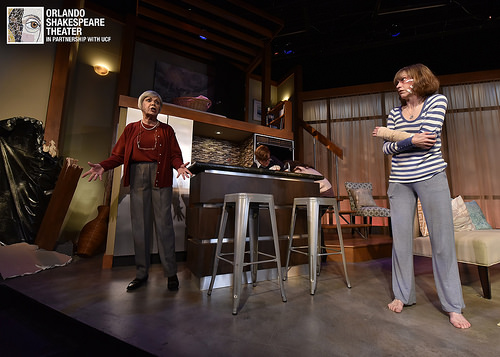
Mrs. LanceAround Thinks This Photo Does Not Do the Set Justice

Mrs. LanceAround Thinks This Photo Does Not Do the Set Justice

We interrupt our ongoing coverage of the 2015 Florida Film Festival to highlight another theatrical art form now gracing the Orlando stage.

The standout star of Orlando Shakes world premiere production of Jennifer Hoppe-House’s Bad Dog is Bob Phillips. Was he the star actor? Member of the supporting cast? Director? Producer?

No, he designed the set.

Using every inch of the intimate Goldman Theatre stage, Bob creates an open floor plan where the action takes place in the kitchen, living room, front porch, upstairs hallway and even the exterior, now interior, wall where the title character rammed her Prius in a drunken stupor. All this without a single set change! For twenty years, Bob has graced the Orlando Shakes theatre with brilliant stage designs that would stand out from Broadway to the West End. While there is much to praise about this production, the fact that this is Bob Phillips’ last set at Orlando Shakes prior to his retirement inspired Mrs. LanceAround and I to bid him farewell with the opening praise of this review. He has won six Emmys and the heart of many an Orlando theatre patron. Cheers to you, Bob!

As for the play, it is as detailed, complicated and beautiful, in a down-to-earth way, as one of Bob’s sets. The story revolves around Molly, The youngest of three sisters, whose relationship with her wife becomes jeopardized when she ends 10 years of clean sobriety and then rams her Prius into the living room of their home. Her family swoops in to “help” including her two sisters, mother, father and father’s mistress-turned-wife of 30 years. The story seems headed for a classic alcoholic intervention. But somehow the tables get turned as each character’s personal dysfunctions are revealed.

Dysfunction Abounds

Dysfunction Abounds

In an ironic intertwining, Molly’s struggle to find herself amidst the dysfunction of her family parallels the attempt of this play to find its center. Is it a comedy or tragedy? Who, if anyone, is the protagonist? Is there an antagonist? Who is right and who is wrong? The play is not afraid to ask difficult questions and certainly does not give any easy answers.

In the first half of the play, comedy takes center stage as each familial dysfunction is hilariously revealed to much laughter from the audience. After the intermission, things become more serious as each character confronts some darkness within.

For her first full length play, Jennifer Hoppe-House has penned an ambitious work. During the post show “talk-back”, the cast reveals they worked closely with the playwright and made several tweaks to the script. As the play continues to find theatres and audiences, no doubt further tweaks will help smooth out some of the minor inconsistencies in character and plot development. Mark Routhier, the director, makes full use of Bob Phillips’ ambitious set. His blocking provides just the right focus as each actor is provided the opportunity to develop their character to their fullest extent.

This is truly an ensemble piece. While Ginger Lee McDermott handles the lead role of Molly with emotional depth, all the actors have their time in the limelight. But it’s the full throttle interactions which occur when most of the characters are together that give this play its most powerful moments. The night Mrs. LanceAround and I attended, the audience was riveted. There was generous laughter at every humorous line. During the most dramatic moments, one could feel the intensity of the audience focused on the action. After the performance, the cast spoke about the differences of each audience. The play would find laughter at different times. They thanked this audience for their responsiveness. Audience members, in return, heaped praise on the cast and indicated how much they loved the show with a standing ovation.

Bad Dog continues through May 3rd. Having a talented regional theatre company like Orlando Shakes in our community is a blessing that deserves your support. We encourage you to make time in your busy schedule and share a theatre experience with someone you love. If you have children, find a babysitter. The intensity of this show is not for the young ones. But teenagers and young adults can certainly handle the themes presented in this play. And you will have a thought provoking evening of theatre.

Tomorrow, we will return to posting the the final blog posts about the Florida Film Festival. Keep reading. And don’t forget to join the conversation by leaving your comments.

FFF 2015 Day 7 Limited Partnership

April 23, 2015
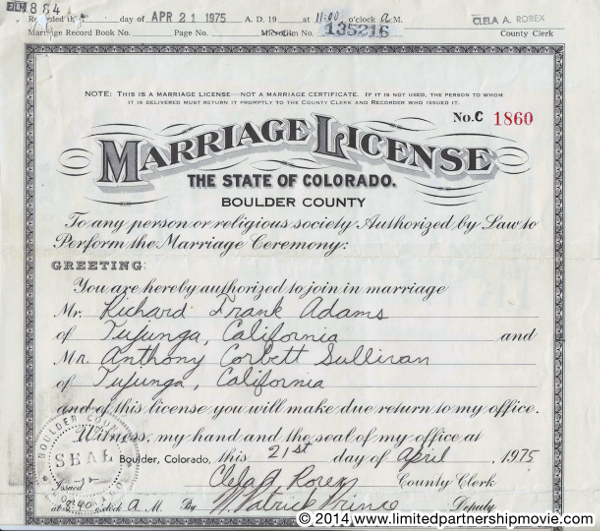
On of the First Legal Gay Marriage License in the U.S.--In 1975!

One of the First Legal Gay Marriage Licenses in the U.S.–In 1975!

Sandorkraut
When Sandor Katz left his political career and moved off the grid to rural Tennessee, he discovered the ancient art of fermentation. He has since become the consummate authority on all things fermented, such as sauerkraut. He lives in an artistic, rustic home. The filmmaker is an artist in his own right who captured the throwback hippie perfectly. Very high quality production values and directorial choices make this film not only educational and interesting to watch, but a fine work of art.

Limited Partnership
Like every member of the audience, tears are rolling down my face. This was a beautiful story about the first gay man, Anthony (Tony) Sullivan, to petition the US Government for the right to be granted a green card on the basis of his legal marriage to another man, Richard Adams. They were married on 21 April 1975.

Yes, 1975. Before being forced to cease, Boulder County married six gay couples in that year.

The official response from the U.S. government’s immigration services to Tony’s request for a green card would be inconceivable today. Tony received a letter that stated, “You have failed to establish that a bona fide marital relationship can exist between two faggots.” A follow up letter of clarification was even more offensive. It contained the viewpoint that one of them could not fulfill the female duties and functions or obligations inherit in the marital situation.

The incredible power of this documentary lies in the two protagonists and the steadfast love and devotion they so obviously shared along with a kindly, gentle spirit with which they address their detractors. These are very special people. The documentary chronicles their 40 year struggle to get permission for Tony to legally reside in America with his spouse.

In 2012, as this documentary was coming to a close and our nation was taking a huge U-Turn in our attitudes towards gay marriage, Richard Adams passed away from lung cancer. Today and unbeknown to the audience, Tony Sullivan was sitting in the Enzian theatre watching the movie with us. Mrs. LanceAround and I had an in depth interview with Tony after the movie. We’ll write a detailed blogpost about that later. Here is the Q & A between Tony and the audience who watched the film with him.

Q & A with Tony Sullivan

Tony: Before the first question, I have to say one thing. I was the loud mouth in the family. Richard always sat back. A lot of people didn’t pay any attention to Richard, this wonderful man that I shared 40 years of my life with. He was a truly unique and wonderful, loving person. I’m so very lucky a human being to have had him in my life! [Generous applause from the audience]

Q: It’s so hard to watch this. It still hurts…

A: It’s hard to watch but also it reminds me as time passes as you lose someone they fade away in time. You start to lose the image of them. I had the luxury of being able to see him, as he was, to hear him, as he was; to see the love in his eyes. At first, when the film was made, it was very difficult for me to watch it. Now I’m beginning to understand that what the filmmaker did has made me grateful.

Q: I don’t know anything about the immigration process, were there other options for getting your green card?

A: I did get married for convenience, to a woman. We have this in Australia. It’s totally a legal and accepted thing. She and I got married and went to the immigration interview. My green card was sitting on the table. And the official wanted to know when had we last had sex. I’m from another culture. I recoiled at the question, absolutely recoiled. I didn’t think any government official had the right to ask that question. It just repulsed me. We never had sex. I was a gay man, she was a happy heterosexual woman. So when I came out of the interview I said to her, “I think we need to annul this marriage.” I came home and I said to Richard, “This is wrong. If they want to know who I have sex with, maybe I should tell them.” We discussed the injustice that went on and decided that someone, someplace needs to do something about this. Then the awful question comes up in a time like this, “Oh dear, why not us?” Someone knew a judge in San Fernando Valley and suggested we go and talk to him. I went and talked to him (I still have his name and phone number in my file.) I went and talked to this judge and he said, “Oh yes, give me $10,000 and I’ll have your green card in days. I’ll give $5000 to an attorney and I’ll keep $5000 myself.” Strangely enough, even though I’m fighting a system on injustice, I couldn’t do criminal things. That, to me, is not acceptable. After that, I went to another state to get the marriage annulled. And the attorney who handled that told me he was the attorney for Frank Sinatra. He said, “Go down the street with me, I’ll get you a green card today.” By that time Richard and I had decided to fight the issue. So I said to him, “No thanks, we’ve got something else in mind.” So, yes, I’ve had some opportunities to get a green card, but we didn’t pursue them.

Q: What advice would you give to the younger activists about going through the issues we have in our day now and how they can stay positive as well as getting more involved.

A: You have to be an optimist. You have to have faith in achieving something. If you don’t achieve it straight away, you know it’s the old expression about losing the battles but winning the war. The battles in the early days were the ones we lost one after another. One of the most famous ones of all being here in Florida. Retain your integrity. You get opportunity after opportunity to settle or compromise, etc. Decide what you believe in; what you really believe in, not what your friends tell you to believe in. Keep that in focus. The other thing I want to say, especially for the gay and lesbian movement, look at the history and philosophy of the feminist movement. For me, I had an amazing source of strength from that. To me, the feminist movement is as profound as the professed beliefs of Christians. I find the words written as the words of Christ…I get a lot of strength from that. The woman’s movement preaches the same thing. If you look to that and then adapt it, which in the gay and lesbian movement gay men should be doing anyhow, I find tremendous strength in that.

Q: Did you get a green card?

A: Haven’t got my green card yet. Sometime last year I wrote a letter to President Obama asking for an apology to Richard. I felt that, as a citizen of the United States he did not deserve to have that letter stuck in the record for him. On the first day of Obama’s new head of immigration being in immigration, at President Obama’s instigation, he wrote a letter in which they apologized for the “faggot” letter.

Q [From LanceAround]: Putting all the issues of this movie aside, how old were you when you came from Australia and what made you decided to make this country your home?

A: America was never a choice of country that I’d want to come to. It was probably the least country I was interested in coming to. I came here in 1971 to see a friend of mine who was the Editor of The American Cinematographer and that’s when I met Richard. I was on my way to England. I had absolutely no intention of staying in America. I didn’t want to stay in America. I didn’t like the politics of America. I didn’t like the politics of Australia at the time, either. I met Richard and we had a thing of communication–an old fashioned thing called the mail–when I was in England. He asked me to come back here and I came back. That’s an unusual thing that makes our case–I was in America because of Richard. There was absolutely no other reason. It took me a long time to adapt to the country. The culture shock was enormous. Now I realize I’m more American than Australian. Even though I’m very critical of the country–I feel everyone should be critical of America–I do want to say this. If we had done what we did in any other country, we would have gotten a hearing. The way they would have solved the problem is they would have rolled around on the floor, laughing their heads off. And we would have been dismissed with humor. Even though I was one of those cranky people who didn’t believe in the government, I have to say America gave us the opportunity to have a life together. Now I’ve come to realize that I’ve become more American than Australian which I never thought would happen.

Q: Can I ask about your mother? [The movie indicates she disowned Tony]

A: I rang her on my 40th birthday to say, “I’d think you’d be thinking of your son on his 40th birthday.” It was a frigid phone call. She also told me if I was ever back in Sydney to not get near her. Richard and I were in Sydney and we walked past and I said to Richard, “There’s my mother’s place.” and he said, “Are you going to go in?” I said, “No.” My mother was a very disturbed woman. One thing we didn’t know about in those days is that she was chemically dependent on prescription pain killers. When I came back here she and I hadn’t communicated. She died in the early 80s. In fact, I only learned last year my whole family for the last 20 years had been told I was dead. Those things happen.

Reactions From the Audience
“I learned something that I’ve never known about before. It’s like going to another country,” shared one film goer.

“Heart wrenching, informative, times are moving very slowly,” says Aviva. “How do you spell that?” I ask. “A-V-I-V-A, the same backwards as forwards,” she replies.

After several movie goers indicate they don’t want to talk, I say to Mrs. LanceAround, “They don’t comment as much when the film is very evocative.”

A group of UCF students who were helping to promote the film exit the theatre. “This was our second time seeing the film, both educationally and emotionally it really works,” says one. “We’ve seen the film a couple weeks ago to prepare for this. And just seeing him sitting there it was really…” “walking in and just, like turning there and seeing him there  was really…”chimes in his friend, both unable to find the right words.

“It was fantastic. It was lovely,” raves a frequent movie goer.

“That was one seriously powerful movie, wasn’t it?” says Sigi, “Yes it was,” I agree. “Oh my goodness,” she continues, “What a story it was!”


FFF 2015 Day 7 The Farewell Party

April 23, 2015
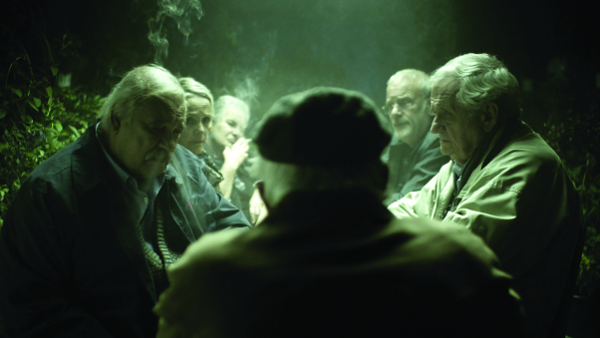
TheFarewellParty

Matthew Assured Us This Film Was Hilarious?

Before the FFF began, I asked Programming Director Matthew Curtis to give me two movies that would make me laugh. His first recommendation was The Farewell Party about euthanasia in a Jewish nursing home.

I didn’t think he heard me correctly, so I repeated, “films that will make me laugh!”

“You will laugh, it’s hilarious,” he replied, chuckling.

Yes, this movie had moments that were quite funny and many that were poignant. But, in the end, it’s a drama…a powerful and well made drama.

Mrs. LanceAround listens to my viewpoint and becomes adamant. “I thought it was touching and loving and funny,” she counters. “It was wonderfully funny. It was not ponderous. But that’s how you make it sound.”

“It had moments that were funny,” I reply, “But in the end I was most moved by the depth of the subject matter.”

“I was touched by the humor, tenderness and genuine love.” She retorts.

In the end, we agree to disagree about which elements of the film were most striking. But we did agree this is a very important movie. In America, our culture has a very difficult time talking about and coming to terms with end of life issues. The more we see films like this and have the conversation, the more mature we become.

The film does take a rather lighthearted approach to the subject matter. It begins with a man helping one of the nursing residents to take her medication by phoning her with an amplification device that makes her believe she is talking to God. She complains that no one in the nursing home believes God calls her! There are also scenes of closeted (literally) homosexuals, an older lady with memory issues who forgets to wear clothing and a group of her friends who make her feel better by throwing her a surprise party where they “forget” as well!

But underneath all the levity is a serious issue. Is it morally responsible to assist someone in taking their own life to end their pain and suffering? Are we obligated to just sit by and watch as the ones we love writhe in pain? The film does not give any easy answers, but it also does not shy away from the tough questions.

Very well filmed, well scripted and topical, this film is a great addition to the 2015 Florida Film Festival!